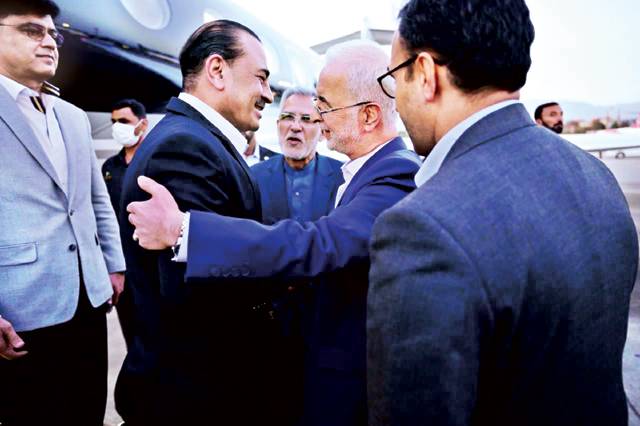

ISLAMABAD/Tehran/WASHINGTON – Chief of Army Staff (COAS) and Chief of Defence Forces (CDF) Field Marshal Syed Asim Munir, NI (M), HJ, arrived in Tehran as part of ongoing mediation efforts on Friday.
“On arrival, he was received and warmly welcomed by Iranian Minister for Interior Eskandar Momeni,” says a press release issued by the Inter-Services Public Relations. Federal Minister for Interior Mohsin Naqvi was also present at the reception.
During the visit, Field Marshal Syed Asim Munir will meet key senior Iranian figures, the sources added. It would be the second such trip to Tehran by Field Marshal Syed Asim Munir amid Pakistani mediation efforts to end the war which began on Feb. 28 when Israel and the US launched military strikes on Tehran.
Iran’s state-run IRNA news agency also confirmed that the Pakistan Army Chief had left for Tehran. During his visit to Iran, Pakistani sources said, Field Marshal Syed Asim Munir will discuss Iran-US talks, regional peace and stability, and other “important issues.” The sources did not disclose details about the duration of the visit.
Interior Minister Mohsin Naqvi has been in Tehran for the past two days as part of indirect talks between the US and Iran. Field Marshal Syed Asim Munir paid a three-day trip to Iran last month when he met both civilian and military leaders of Iran. He had held separate meetings with Iranian President Masoud Pezeshkian, Parliament speaker Mohammad Bagher Ghalibaf, Foreign Minister Abbas Araghchi as well as the Iranian armed forces’ Khatam al-Anbiya Central Headquarters Commander Maj. Gen. Ali Abdollahi. COAS Asim Munir is directly involved in mediation between Washington and Tehran aiming to permanently end the war.
Also, US Secretary of State Marco Rubio said Friday there had been “some slight progress” regarding the situation involving Iran and the Strait of Hormuz.
“There’s been some slight progress, I don’t want to exaggerate it, but there’s been a little bit of movement, and that’s good,” Rubio told reporters ahead of a NATO foreign ministers’ meeting alongside NATO Secretary-General Mark Rutte.
Rubio said the “fundamentals remain the same,” adding: “Iran can never have nuclear weapons, it just cannot make them.”
He said Washington was awaiting the outcome of ongoing discussions related to Iran, while underlining that issues surrounding uranium enrichment and Tehran’s stockpile of highly enriched uranium would have to be addressed. Rubio also accused Iran of attempting to establish a “tolling system” in the Strait of Hormuz, saying Tehran was trying to persuade Oman to join the initiative. “There is not a country in the world that should accept that,” he said, calling the idea “not acceptable.”
“If that were to happen in the Straits of Hormuz, it will happen in five other places around the world,” Rubio added.
The top US diplomat said Washington was working through the UN on a Bahrain-sponsored resolution related to the issue, claiming it had garnered broad international backing.
“Let’s see if the United Nations still works,” Rubio said, while criticising unnamed Security Council members allegedly considering vetoing the resolution.
Later, speaking to the reporters on the sidelines of the summit, Rubio said the US would love to see an agreement with Iran, “in which the Straits are open and they abandon their nuclear ambitions.”
“But we also have to have a plan B. What if Iran refuses to open the Straits? At that point, something has to be done about it,” he said.
On the reports that Qatar sent a team to Tehran for negotiations, Rubio said the primary interlocutor is Pakistan, which has done an “admirable job.”
“We are in constant communication with (Pakistan’s army chief) Field Marshal Asim Munir at the highest levels of our government,” he added. “There’s been some progress. I wouldn’t exaggerate it. I wouldn’t diminish it,” Rubio said. “There’s more work to be done. We’re not there yet. I hope we get there.”
Iran’s Foreign Ministry spokesman Esmaeil Baghaei has said that peace negotiations with the United States are not “close”, adding that it is difficult to say whether a deal could be reached within “weeks or months”, Al Jazeera reported.
State media quoted him as saying that the gaps between Tehran and Washington remain “deep and significant”.
“We cannot necessarily say that we have reached a point where an agreement is close,” he said. “The focus of the negotiations is on ending the war. Details related to the nuclear issue are not being discussed at this stage.”
Iran said Friday it is not seeking “any concessions” from the United States, insisting that Tehran only wants its rights restored and sanctions lifted, according to Iran’s Tasnim news agency.
“We do not want any concessions from the United States; we are only seeking our rights,” Iranian Foreign Ministry spokesman Esmaeil Baghaei said, according to the report.
The spokesman said Iran was demanding “an end to America’s criminal actions against the Iranian people.” “Sanctions must be lifted, Iran’s frozen assets must be released and made available to the country,” he said.
“For the past five decades, we have been subjected to what they themselves call ‘crippling sanctions,’” he added.
Baghaei said the sanctions were imposed under various pretexts, primarily over what Washington describes as Iran’s nuclear threat.
“There has been no nuclear threat from Iran against any actor in the region or the world,” he added.
Baghaei also addressed developments related to the Strait of Hormuz, criticizing the US naval blockade as “completely contrary to international law.” He called on Washington to take steps to end the blockade.
A Qatari negotiating team arrived in Tehran on Friday in coordination with the United States to try to help secure a deal to end the war with Iran and resolve outstanding issues, a source with knowledge of the matter told Reuters on Friday.
“A Qatari negotiation team is in Tehran on Friday,” the source said, adding that the team had traveled in coordination with the United States and was there to help “reach a final deal that would end the war and address outstanding issues with Iran.”
The Qatari Ministry of Foreign Affairs did not immediately respond to a request for comment.
While Pakistan has served as the official mediator since fighting began, Qatar’s re-engagement reflects its longstanding role as a US ally in the region and a trusted back-channel between Washington and Tehran.