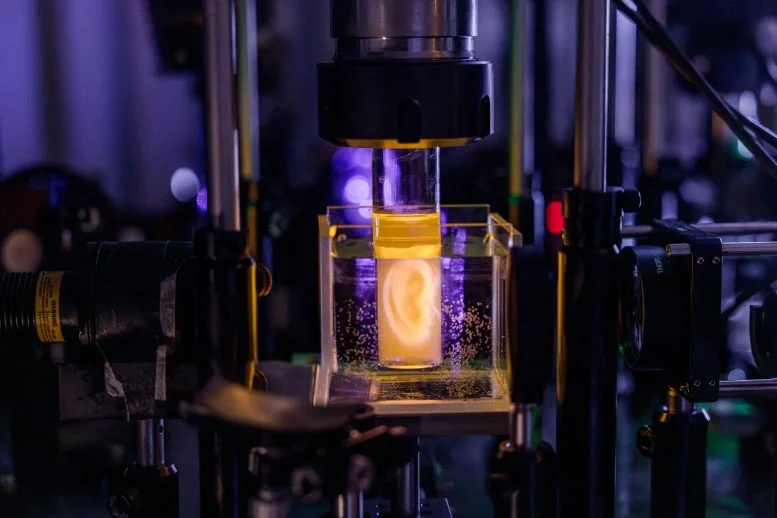
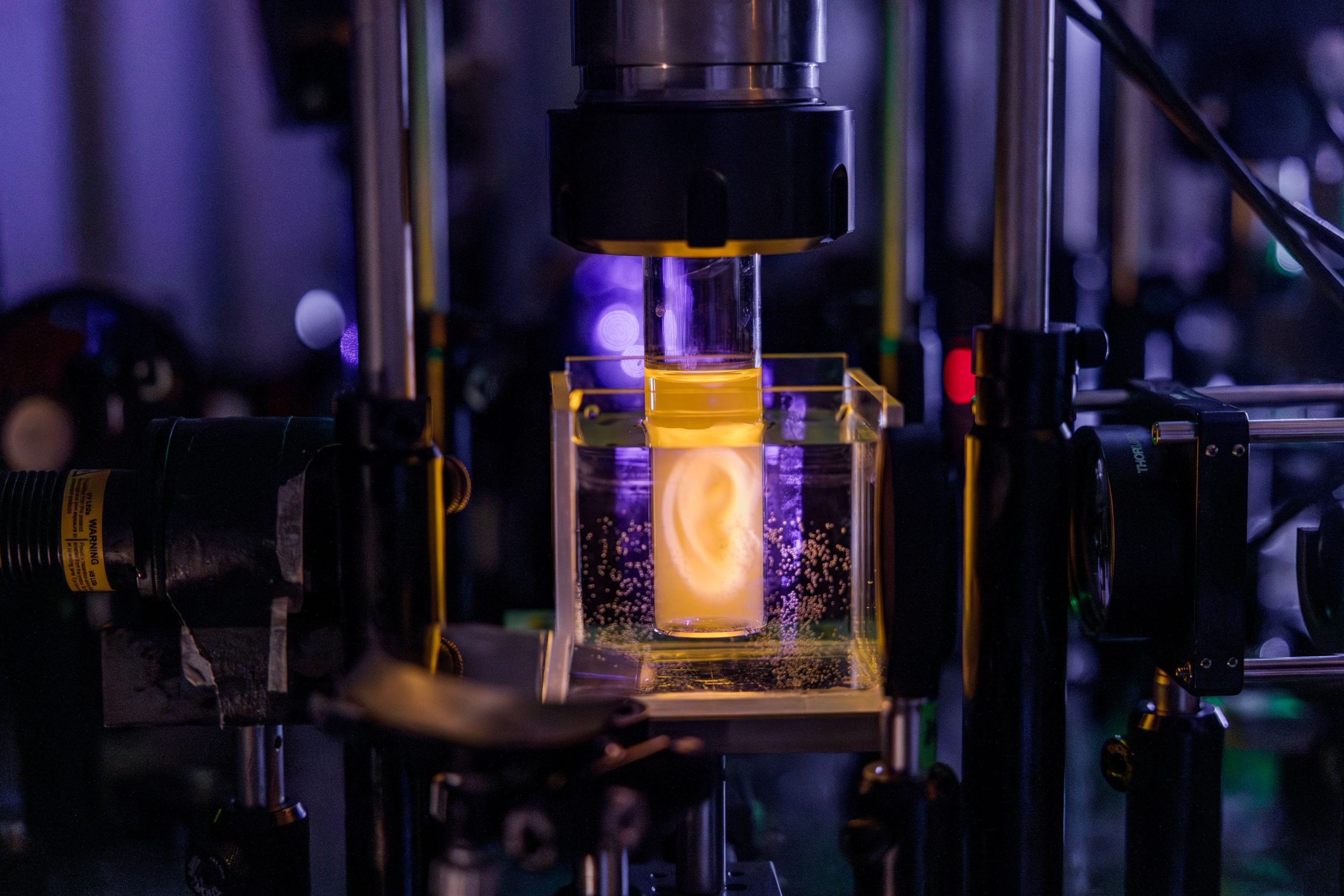
A new holographic 3D-printing platform can produce detailed living structures faster, larger, and with greater accuracy than previous methods.
What if a 3D printer could create soft, living tissue in seconds instead of slowly building it layer by layer? Researchers at EPFL are moving closer to that goal with a major upgrade to a futuristic manufacturing technique that uses holograms and laser light to instantly form complex objects inside liquid resin.
The technology, known as tomographic volumetric additive manufacturing (TVAM), works more like a CT scan in reverse than a traditional 3D printer. Instead of stacking material one layer at a time, the system projects patterns of light into a rotating vial filled with photosensitive resin. Wherever enough light energy accumulates, the liquid rapidly solidifies into a complete 3D structure.
In earlier work published in 2025, EPFL scientists improved the process by using holograms to control the phase of light waves rather than their brightness. That change allowed the system to preserve far more laser energy, making the printing process dramatically more efficient.
Now, researchers from EPFL’s Laboratory of Applied Photonic Devices (LAPD) have pushed the technology even further. Their latest platform is 70 times more efficient than previous holographic TVAM systems thanks to a newly developed device that directly controls the phase of a laser beam inside a volumetric 3D printer for the first time.
Faster and More Precise Holographic Printing
During testing, the team produced millimeter-scale objects in seconds and centimeter-scale objects within minutes. The phase-controlled system also supports self-healing beams, allowing the printer to create more accurate structures in materials that scatter light, including those containing living cells.
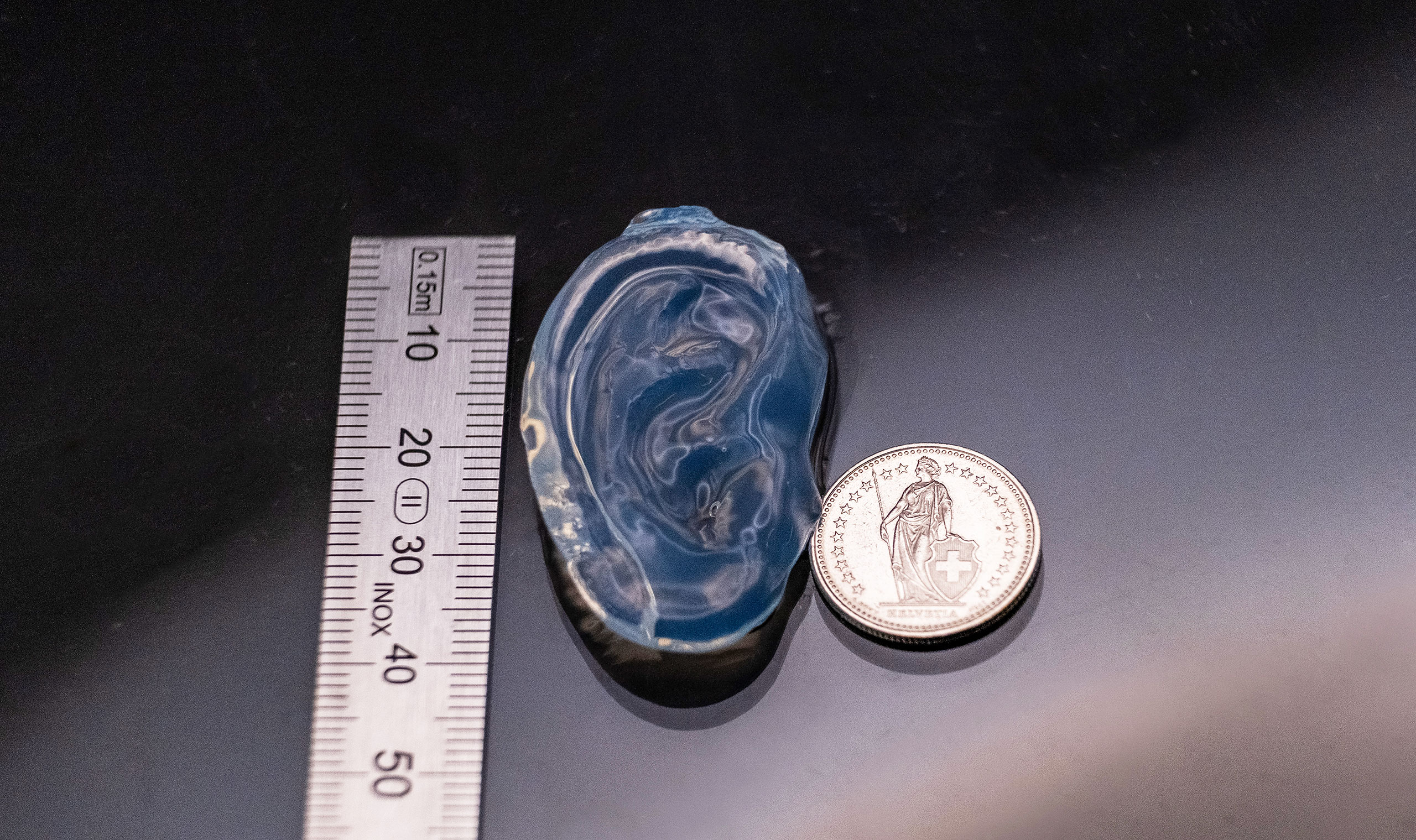
“Our method’s demonstrated efficiency and precision finally makes it possible to bioprint tissue-like structures at near-clinical scale,” says LAPD head Christophe Moser. “We have printed structures substantially larger than those achieved with previous holographic approaches, despite increased light scattering caused by the embedded cells.”
The findings were published in Light: Science & Applications.
Using a 150 mW laser diode, the researchers printed a life-sized human ear, marking progress toward bioprinted implants for reconstructive medicine. In another experiment involving a smaller print construct (volume 64 mm3), the embedded living cells remained viable after six days and formed organized cellular networks.
To improve surface smoothness, the researchers paired their light engine with a new technique that reduces speckle, a type of random light interference that can create rough or grainy textures.
“Our approach brings volumetric printing closer to real-scale implants, and biologically compatible manufacturing using low-power laser sources, ” summarizes lead author and LAPD PhD student Maria Alvarez-Castaño.
Future Improvements for Volumetric 3D Printing
The team says future research will focus on improving projection accuracy and exploring how beam shaping performs in bioresins containing high concentrations of cells.
Additional upgrades planned for future TVAM systems include methods for printing directly onto or around existing objects, along with improved control of microscopic features by predicting how chemicals inside the resin respond during printing.
One of the most notable developments uses holographic volumetric additive manufacturing to create objects by projecting a hologram directly onto a resin-filled vial, removing the need to rotate the container during printing.
Reference: “High-efficiency multi-scale holographic volumetric 3D printing with a phase light modulator” by Maria Isabel Álvarez-Castaño, Riccardo Rizzo, Viola Sgarminato, Ye Pu and Christophe Moser, 19 May 2026, Light: Science & Applications.
DOI: 10.1038/s41377-026-02331-4
Never miss a breakthrough: Join the SciTechDaily newsletter.
Follow us on Google and Google News.