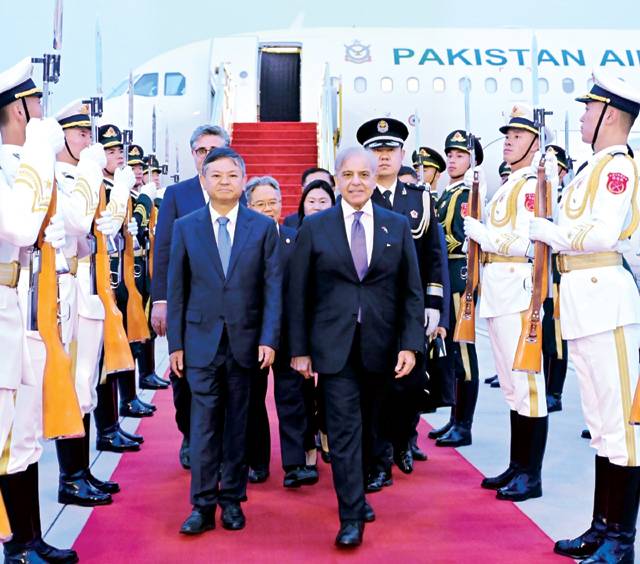

Islamabad – Prime Minister Shehbaz Sharif arrived in Beijing after concluding his official engagements in Hangzhou, Zhejiang Province, at a time when rapidly evolving geopolitical developments across the region have enhanced the strategic significance of Pakistan-China consultations. The prime minister was received at Beijing Capital International Airport by Chinese Minister for Environment and Ecology Huang Runqiu.
During his stay in Beijing, Prime Minister Shehbaz Sharif is scheduled to hold high-level meetings with Chinese President Xi Jinping and Chinese Premier Li Qiang. The discussions are expected to focus on further deepening the Pakistan-China All-Weather Strategic Cooperative Partnership, accelerating cooperation under the second phase of the China-Pakistan Economic Corridor, and expanding collaboration in trade, investment, industrial development, agriculture, science and technology, connectivity, and people-to-people exchanges.
The visit comes at a particularly consequential moment for the region, amid intensifying diplomatic activity surrounding the evolving Iran-United States engagement process, ongoing security challenges in South Asia, and increasing competition among major powers across the Indo-Pacific and wider Asian region.
Diplomatic observers believe the Beijing visit reflects the continued strategic coordination between Pakistan and China on regional stability, economic integration, and emerging geopolitical realities.
The engagements are also expected to include exchanges on regional peace and security, particularly in the context of recent tensions in the Middle East, Afghanistan-related security concerns, and broader efforts aimed at maintaining strategic balance in the region.
The timing of the visit is being viewed as especially important as Pakistan continues to position itself as a constructive diplomatic actor advocating dialogue, de-escalation, and regional connectivity.
Analysts say Islamabad’s close coordination with Beijing carries added importance at a time when several regional powers are recalibrating their strategic priorities amid shifting global alignments.
The two sides are also expected to review progress on key CPEC Phase-II initiatives, including industrial relocation, Special Economic Zones, green development, energy transition, digital connectivity, and agricultural modernization.
Pakistan considers Chinese investment and industrial cooperation central to its long-term economic stabilization and development agenda.
This year also marks the 75th anniversary of the establishment of diplomatic relations between Pakistan and China — a relationship widely regarded as one of the most enduring strategic partnerships in international diplomacy.
Over the decades, Beijing and Islamabad have maintained close cooperation in economic, political, defense, and regional affairs, with both countries consistently reaffirming support for each other’s core interests.
Officials say the Prime Minister’s visit is expected to further consolidate bilateral strategic trust and open new avenues of cooperation at a time of significant geopolitical transformation across Asia and beyond.