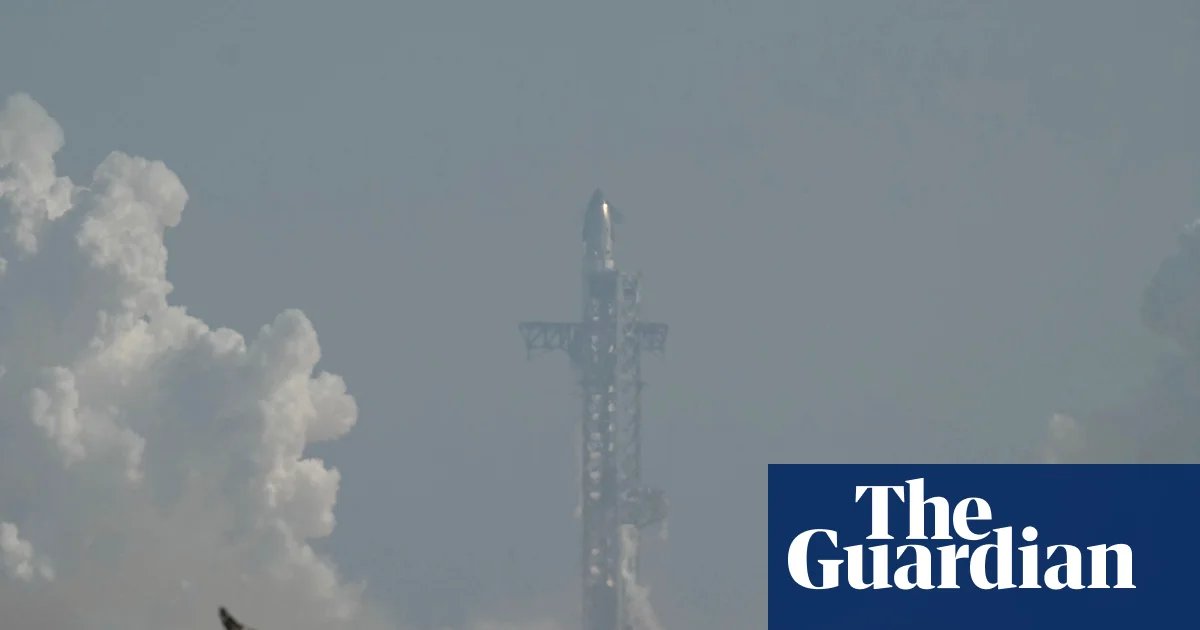
SpaceX has launched its biggest, most powerful Starship yet, an upgraded version that Nasa is counting on to land astronauts on the moon.
The redesigned mega-rocket made its debut two days after SpaceX’s CEO, Elon Musk, announced he was taking the company public. It blasted off from the southern tip of Texas on Friday, carrying 20 mock Starlink satellites that were released midway through the hour-long spaceflight that stretched halfway around the world.
The spacecraft reached its final destination, the Indian Ocean, despite some engine trouble, before erupting in flames upon impact. That last part was not unexpected, according to SpaceX.
Musk described it as an “epic” launch and landing. “You scored a goal for humanity,” he told his team via X.
It was the 12th test flight of the rocket that Musk is building with the eventual aim of taking people to Mars. But first comes the moon and Nasa’s Artemis programme.
The Nasa administrator, Jared Isaacman, flew in for the launch, saying Starship was now one step closer to the moon.
The last of the old space-skimming Starships lifted off in October. SpaceX’s third-generation Starship – a souped-up version called V3 – soared from a new launchpad at Starbase, near the Mexican border. Last-minute pad issues thwarted Thursday evening’s launch attempt.
SpaceX was hoping to avoid the fireworks it experienced during back-to-back launches last year when midair explosions rained wreckage down on the Atlantic. Earlier flights also ended in flames.
There was no fireball this time until the very end. The spacecraft plummeted upright into the Indian Ocean apparently under full control, then toppled over and ignited.
While the liftoff itself went well, not all of the engines fired as the booster attempted a controlled return. The spacecraft also had to make do with fewer engines, but kept heading eastward 120 miles (193km) up. A pair of modified, camera-equipped Starlinks that were ejected from Starship provided brief views of the spacecraft in flight – a remarkable first.
At 124 metres long (407ft), the latest model is slightly larger than older Starship lines and packs more engine thrust.
The revamped booster sports fewer but bigger and stronger grid fins for steering it back to Earth after liftoff, and a larger and more robust fuel transfer line to feed the 33 main engines. This fuel line is the size of SpaceX’s Falcon 9 first-stage booster. The retro-looking, stainless steel spacecraft also has more of everything – more cameras and more navigation and computer power – as well as docking cones for future rendezvous and moon missions.
Starship is meant to be fully reusable, with giant mechanical arms at the launch pads to catch the returning rocket stages. But on this latest trial run, nothing was being recovered. The Gulf of Mexico marked the end of the road for the redesigned first-stage booster, and the Indian Ocean for the spacecraft and its satellite demos.
Nasa is paying SpaceX billions of dollars – and also Jeff Bezos’s company Blue Origin – to provide the lunar landers that will be used to land Artemis astronauts on the moon.
The two companies are scrambling to be first. While Starship has reached the fringes of space on multiple flights lasting an hour at most, Bezos’s Blue Moon has yet to lift off, although a prototype is being readied for a moonshot later this year.
Nasa is following April’s successful lunar flyby with four astronauts onboard with a docking trial run in orbit around Earth planned for next year. For that Artemis III mission, astronauts will practice docking their Orion capsule with Starship, Blue Moon or both.
Artemis IV, a moon landing by two astronauts, could follow as soon as 2028 using either Starship or Blue Moon, whichever lander is safer and ready first. It will be Nasa’s first lunar landing with a crew since 1972’s Apollo 17. The goal this time is a moon base near the lunar south pole, staffed by astronauts as well as robots.
SpaceX is already taking reservations for private flights to the moon and Mars on Starship.
The world’s first space tourist, the US businessman Dennis Tito, and his wife signed up three and a half years ago for a flight around the moon. The timing is uncertain.
This week, another wealthy space tourist, the Chinese-born bitcoin investor Chun Wang, announced he would fly to Mars on Starship’s first interplanetary mission. Wang previously chartered a SpaceX polar flight in a Dragon capsule last year and, along with his hand-picked crew, became the first to orbit above the north and south poles.
No price tag or date was revealed for his Mars cruise.