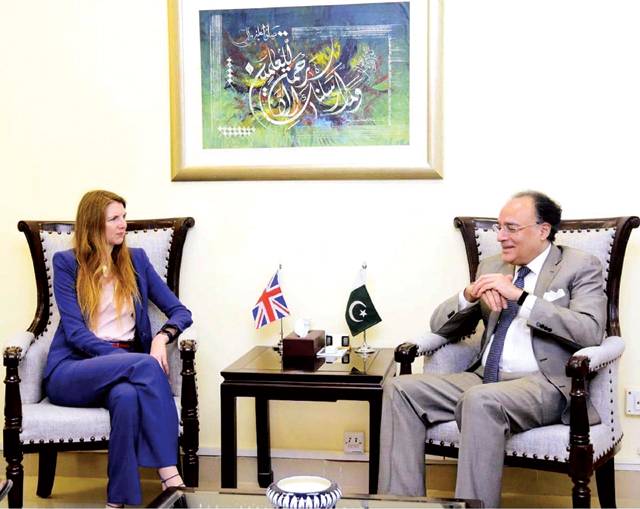

ISLAMABAD – Federal Minister for Finance and Revenue Senator Muhammad Aurangzeb on Monday emphasized the government’s commitment to policy continuity, fiscal discipline, and structural reforms, including efforts to improve public sector efficiency, strengthen institutional coordination, and create an enabling environment for private sector-led growth and investment.
The minister held a meeting with Ms Jane Marriott CMG OBE, British High Commissioner to Pakistan, who called on the minister at the Finance Division. The meeting focused on Pakistan–United Kingdom bilateral cooperation, economic reforms, regional developments, and continued engagement on matters of mutual interest. During the meeting, the finance minister shared the government’s perspective on the evolving global economic environment and its implications for Pakistan’s economy, particularly in the context of regional geopolitical developments and energy market volatility. He outlined the government’s ongoing efforts to maintain macroeconomic stability, manage external sector pressures, and sustain the momentum of economic reforms aimed at ensuring long-term growth and resilience.
Senator Aurangzeb highlighted improvements in key economic indicators, including stability in the external account, continued strength in remittance inflows, and growing investor confidence. He also briefed the British high commissioner on measures being undertaken to broaden the tax base, strengthen revenue mobilization, improve compliance, and enhance transparency through technology-driven reforms and digitalization initiatives. The finance minister further emphasized the government’s commitment to policy continuity, fiscal discipline, and structural reforms, including efforts to improve public sector efficiency, strengthen institutional coordination, and create an enabling environment for private sector-led growth and investment. Discussions also covered the importance of effective communication and public engagement in sustaining support for the reform agenda. Regional and global developments, including their economic and humanitarian implications, also came under discussion. Both sides acknowledged the importance of dialogue, international cooperation, and coordinated efforts to address emerging challenges affecting economic stability and global supply chains.
The British high commissioner appreciated Pakistan’s continued engagement on regional issues and reaffirmed the United Kingdom’s support for Pakistan’s economic reform efforts and development priorities. Matters relating to climate resilience, population planning, social sector coordination, and cooperation with international financial institutions were also discussed during the meeting. The meeting ended with a shared commitment to further strengthening Pakistan-United Kingdom bilateral relations and enhancing cooperation across economic, development, and institutional sectors. Senator Muhammad Aurangzeb also met with a delegation of Pakistan Tobacco Company (PTC) at the Finance Division. The delegation was led by Usman Zahur, Area Director (APMEAC) & General Manager Pakistan, and included senior representatives from marketing, corporate affairs, and fiscal affairs.
During the meeting, the finance minister outlined the government’s broader fiscal reform agenda focused on strengthening revenue mobilization, broadening the tax base, improving enforcement, and enhancing transparency through technology-driven systems. He noted that ongoing reforms in tax administration centered on people, processes, and technology are aimed at improving compliance, reducing leakages, and ensuring fair revenue collection across the economy.
The minister highlighted that enhanced enforcement measures, supported by digitization, technology-based monitoring systems, and coordinated operations by relevant agencies, are contributing to improved compliance and revenue collection in several sectors. He noted that enforcement actions in industries including sugar, cement, beverages, textiles, and tobacco are helping address illicit and undocumented economic activity.
The PTC delegation appreciated the government’s reform and enforcement initiatives and shared views on the tobacco sector, including excise taxation, illicit trade, market dynamics, and export competitiveness. The delegation acknowledged recent actions against illegal and non-compliant operators and emphasized the importance of a stable and predictable taxation framework to support formal sector growth and sustainable revenue generation.
Discussions also covered regulatory and taxation issues, sectoral competitiveness, market trends, and the importance of strengthening enforcement to reduce the share of illicit products operating outside the documented economy. Both sides exchanged views on coordinated enforcement mechanisms involving federal and provincial authorities.
The finance minister reiterated that revenue mobilization and effective enforcement remain central to the government’s fiscal reform agenda. He emphasized that while the government is committed to ensuring policy consistency and strengthening compliance, all sector-specific proposals would be evaluated in line with broader fiscal objectives and economic priorities.
The meeting also discussed export potential and investment opportunities within the tobacco sector and related value-added products. The delegation highlighted Pakistan’s role as a regional manufacturing and export base for certain product categories and shared perspectives on international market opportunities. Discussions further included regional experiences relating to enforcement, taxation models, and regulatory practices in comparable markets.
The finance minister appreciated the delegation’s input and reaffirmed the government’s commitment to continued engagement with the formal business sector to support investment, exports, industrial activity, and sustainable economic growth. He stated that the government would continue pursuing reforms aimed at improving the ease of doing business, strengthening compliance systems, and creating a more transparent and competitive economic environment.