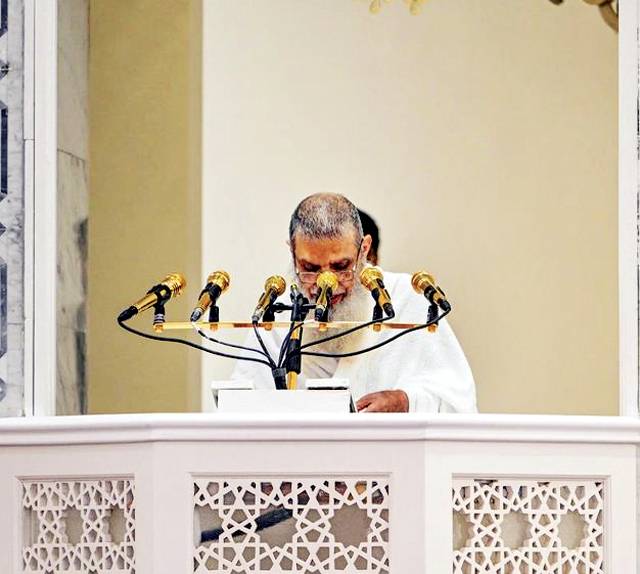

ARAFAT – Marking the pinnacle of the annual pilgrimage of Hajj, more than 1.6 million pilgrims started their main ritual of standing at Arafat on Tuesday afternoon after ascending the vast plains of Arafat earlier the day.
Sheikh Ali bin Abdulrahman Al-Hudhaifi, imam and khateeb of the Prophet’s Mosque, delivered the Arafat sermon at the grand Namira Mosque on Tuesday. The sermon resembles the famous farewell sermon of Prophet Muhammad (peace be upon him) when he performed his only Hajj.
In the sermon, Sheikh Al-Hudhaifi emphasised that Hajj is a fundamental pillar of Islam rooted in absolute monotheism and submission to Allah. “A proper pilgrimage requires excellent conduct, truthful speech, and the avoidance of sins, disputes, and partisan or political slogans,” he said.
Sheikh Al-Hudhaifi underscored that the pilgrimage serves as a vital platform for mutual acquaintance, harmony, cooperation, and unity among Muslims of all nationalities and backgrounds. After the sermon, Sheikh Al-Hudhaifi led the prayers. Retracting the noble tradition of the Prophet (PBUH), he performed Dhuhr and Asr prayers, combined and shortened, with one adhan and two iqamas.
Over 1.8 million faithful performed the Rukn-e-Azam of Hajj, Wuqoof-e-Arafat, in Maidan-i-Arafat. Sheikh Ali Al-Hudhaify urged Muslims to forge unity among themselves. He stressed the need to fear Allah and pursue piety.
The Imam reminded believers that Islam unites hearts beyond borders, languages and colours. Describing Hajj as a living manifestation of one Ummah standing together before Allah, he said true honour lies in piety, sincerity and Tawheed.
The Imam prayed that Allah Almighty may unite the hearts of Muslims upon truth, accept the Hajj of the pilgrims, and return them safely to their homes. He also prayed for the peace, prosperity and unity of the Muslim Ummah.
Pilgrims joined the prayers at and around Namira Mosque, and then started performing the Standing (wuqoof) at Arafat. Wuqoof Arafat, one of the four pillars of Hajj, begins after Dhuhr prayers. Pilgrims would engage in prayers and supplications until after sunset. They will seek forgiveness and pleasures of Allah. Many of the worshippers were seen holding umbrellas against the fierce sun while chanting Talbiyah and reciting verses from the Holy Qur’an after ascending on Jabal Al-Rahma (the Mount of Mercy) in Arafat. The vast plains of Arafat spread over an area of 10.4 square km and is inhabited only during the Arafat Day.
Chanting “Labbaik Allahumma Labbaik (O God, here I am answering Your call)…,” the pilgrims flocked this morning to Namira Mosque, about 22 km southeast of the Grand Mosque in Makkah, after spending a night of meditation and introspection in the Tent City of Mina. Male pilgrims in seamless white clothes — resembling a white sea of humanity and women in their abayas — are now spending the most crucial hours in their lifetime spiritual journey.
After spending a whole day and night in Mina in prayers and meditation on the first day of Hajj (Yaum Al Tarwiyah) on Monday, the pilgrims proceeded to Arafat on board Mashair train, buses and other vehicles. All roads to Arafat were packed with worshippers as helicopters buzzed overhead and volunteers handed out bottles of water. The chanting of talbiya reverberated all around as the pilgrims headed to Arafat in an air of spirituality that marked the climax of their lifetime spiritual journey. Since the early morning hours, crowds of pilgrims have been arriving at Namira Mosque to perform the Dhuhr and Asr prayers and to listen to the Arafah sermon amid a spiritual atmosphere filled with tranquility and peace.
The pilgrims took their places in the 110,000-square-meter Namira Mosque and 8000-square-meter courtyards well before the start of the Arafat Day sermon. The mosque and its courtyards witnessed smooth movement of pilgrims, thanks to on-site monitoring by relevant authorities that mobilized all organizational and service capabilities to ensure the pilgrims’ comfort and facilitate the performance of rituals in a peaceful environment.
On this blessed day, the pilgrims engage in the “Talbiyah” supplication, remembrance of Allah, seeking forgiveness, and praising Almighty God. They turn humbly and devotedly to Allah, spending the day praying for themselves, their families, their children, and all their fellow Muslims. Multitudes of pilgrims are standing shoulder to shoulder, feet to feet, for the emotional day of supplication in the desert valley.
The pilgrims would remain at Arafat until nightfall in deep contemplation, supplication and recitation of the Holy Qur’an. After completing the ritual of standing at Arafat by sunset, pilgrims then move to Muzdalifah in a calm and dignified manner, reciting talbiyah a great deal. They will offer the Maghrib prayer with three raka’a and Isha prayer in two raka’a at the time of Isha after reaching Muzdalifah, and spend the night there in supplication.
Muslims in most parts of the world observed fasting on Tuesday in a sign of solidarity with the pilgrims. It is a great Sunnah for those who do not perform Hajj to observe fasting on Arafat Day.