
Says both sides must take their time Pezeshkian says Iran not seeking nuclear weapons, but ‘honour and dignity’ non-negotiable US official says Washington, Tehran reach preliminary deal to reopen Strait of Hormuz: NYT.
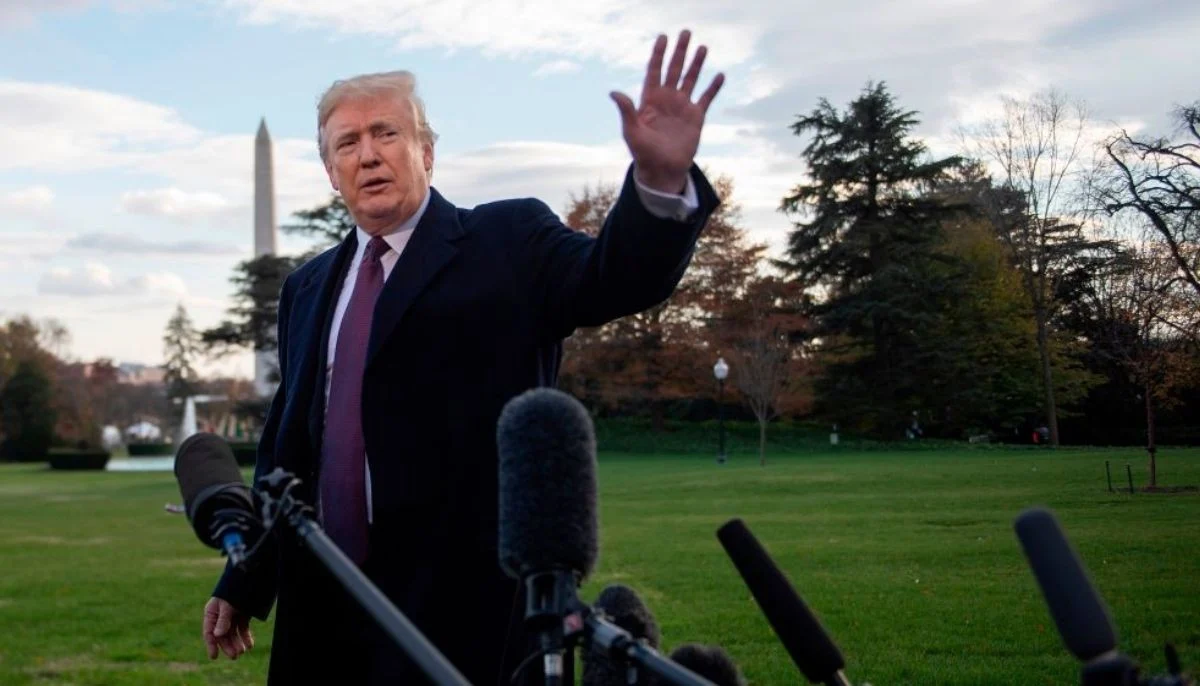
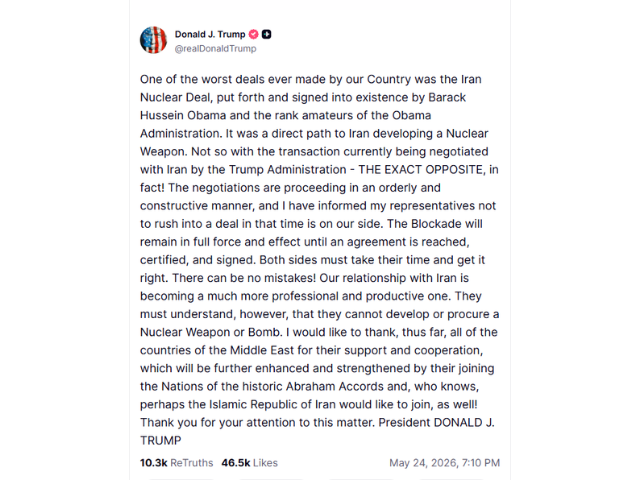
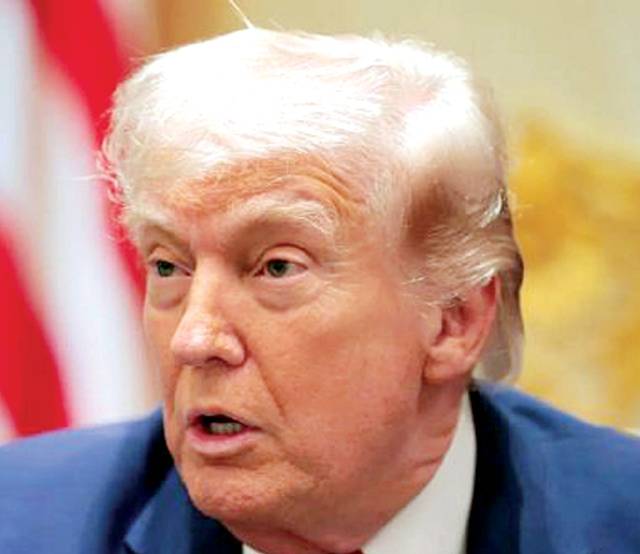
WASHINGTON/ISLAMABAD – US President Donald Trump said on Sunday he had told his representatives not to rush into any deal with Iran, appearing to dampen hopes of an imminent breakthrough in the three-month-old war that had been raised by both sides a day earlier.
The US blockade on Iranian ships on the Strait of Hormuz would “remain in full force and effect until an agreement is reached, certified, and signed”, Trump wrote on Truth Social.
Negotiations were progressing and the U.S. relationship with Iran had become more professional and productive, he said. But he added: “Both sides must take their time and get it right. There can be no mistakes!”
A day earlier, Trump said Washington and Iran had “largely negotiated” a memorandum of understanding on a peace deal that would reopen the Strait of Hormuz, which before the conflict carried one-fifth of global oil and liquefied natural gas shipments.
Trump has repeatedly played up the prospect of an agreement to end the war that the US and Israel started on February 28, so far without success. It was not clear whether the agreement he was referring to on Sunday was the initial memorandum of understanding that has been under discussion, or a much more challenging broad peace settlement, likely to take much longer.
The two sides remain at odds over numerous difficult issues, such as Iran’s nuclear ambitions and Tehran’s demands for the lifting of sanctions and the release of tens of billions of dollars of Iranian oil revenues frozen in foreign banks. Various media in the U.S. and Iran had said the memorandum setting out a framework for ending months of fighting would, if concluded, lift a US blockade on Iranian shipping and reopen the waterway, which Iran has shut with threats to attack shipping.
A senior Iranian source earlier told Reuters that if Iran’s Supreme National Security Council approved the memorandum, it would be sent to Supreme Leader Ayatollah Mojtaba Khamenei for final approval.
But Iran’s Tasnim news agency said differences remained over one or two clauses. Tasnim cited a source as saying there would be no final understanding if the U.S. continued to create obstacles.
In another potential stumbling block, a military adviser to Khamenei said Tehran had the legal right to manage the Strait of Hormuz, though it was not clear if that meant continuing to decide which ships can go through.
Meanwhile, The US and Iran agreed in principle to a deal that would reopen the Strait of Hormuz, in exchange for Tehran’s commitment to dispose of its highly enriched uranium, a US official said, according to a report by The New York Times on Sunday.
The official said that the agreement had not yet been signed and remained subject to final approval by US President Donald Trump and Iran’s Supreme Leader Mojtaba Khamenei, a process that could take several days, noting that the method for disposing of Iran’s highly enriched uranium was still being negotiated.
The proposed deal does not address Iran’s missile stockpile nor include a moratorium on uranium enrichment, the official said, adding that these issues were expected to be handled in future rounds of talks.
According to a Fox News report on Sunday, the official suggested that the US could consider “significant accommodations” on sanctions relief if Iran agreed to make similar concessions regarding its enriched uranium stockpile.
“Our plan is to deal with all of their stockpile of the enriched material,” the official said, adding that Washington sees Tehran making “serious accommodations” not previously seen in earlier negotiations, according to the report.
The official also rejected the idea of any “tolling” mechanism for the Strait of Hormuz, saying such an arrangement would not be acceptable and had not been proposed by either side, the report noted.
According to a separate CBS News report, the official said the administration viewed the emerging agreement as stronger than the 2015 nuclear deal reached under former US President Barack Obama, which allowed uranium enrichment up to certain levels.
Any deal cementing the current fragile ceasefire would bring relief to markets but not immediately quell a global energy crisis, which has driven up costs of fuel, fertilizer and food.
Even if the war ends now, full flows through the strait will not return before the first or second quarter of 2027, the head of the Abu Dhabi National Oil Company said last week.
Iran’s Revolutionary Guards said 33 vessels had passed through the strait over the past 24 hours after getting permission from Tehran, still far short of the 140 on a typical day before the war.
Trump, while offering various war aims during the conflict, has repeatedly said the US struck Iran to prevent it from obtaining nuclear weapons.
Iran “must understand, however, that they cannot develop or procure a Nuclear Weapon or Bomb”, he reiterated in his post on Sunday.
Iran has long denied it is pursuing such weapons and says it has a right to enrich uranium for civilian purposes, although the purity it has achieved far exceeds that needed for power generation.
Sources have told Reuters the proposed framework, when it emerges, will unfold in three stages: formally ending the war, resolving the crisis in the Strait of Hormuz and launching a 30-day window for negotiations on a broader agreement, which can be extended.
Trump, whose approval ratings have been hit by the war’s impact on U.S. energy prices, said on Friday he would not attend his son’s wedding this weekend, citing Iran among the reasons for staying in Washington.
He spoke on Saturday with leaders from Saudi Arabia, Qatar, the United Arab Emirates, Jordan, Egypt, Turkey and Pakistan, who encouraged Trump to agree to the emerging framework, Axios reported.
Iranian Foreign Ministry spokesperson Esmail Baghaei said on Saturday that “the trend this week has been towards a reduction in disputes, but there are still issues that need to be discussed through mediators”.
Meanwhile, Iran is ready to reassure the international community that it is not pursuing nuclear weapons or instability in the region, President Masoud Pezeshkian said on Sunday.
“Prior to the martyrdom of Ayatollah (Ali) Khamenei, Iran’s late Leader, we declared — and we reiterate now — that we are ready to assure the world we do not seek nuclear weapons,” Pezeshkian said in remarks carried by state-run news agency IRNA.
“It is rather Tel Aviv that is driving regional instability,” he said, accusing Israel of pursuing a vision of “Greater Israel.” Iranian negotiators will never compromise on the country’s “honor and dignity,” added Pezeshkian.
A potential memorandum of understanding (MoU) between Iran and the US includes an end of the war on all fronts, Tasnim news agency reported on Sunday.
This includes Israel’s attacks in Lebanon, and that Washington would also commit to waiving sanctions on Iran’s oil during negotiations.
Iran, the news agency said, emphasises the enforcement of its sovereign rights over the Strait of Hormuz through various means, the details of which will be announced later.
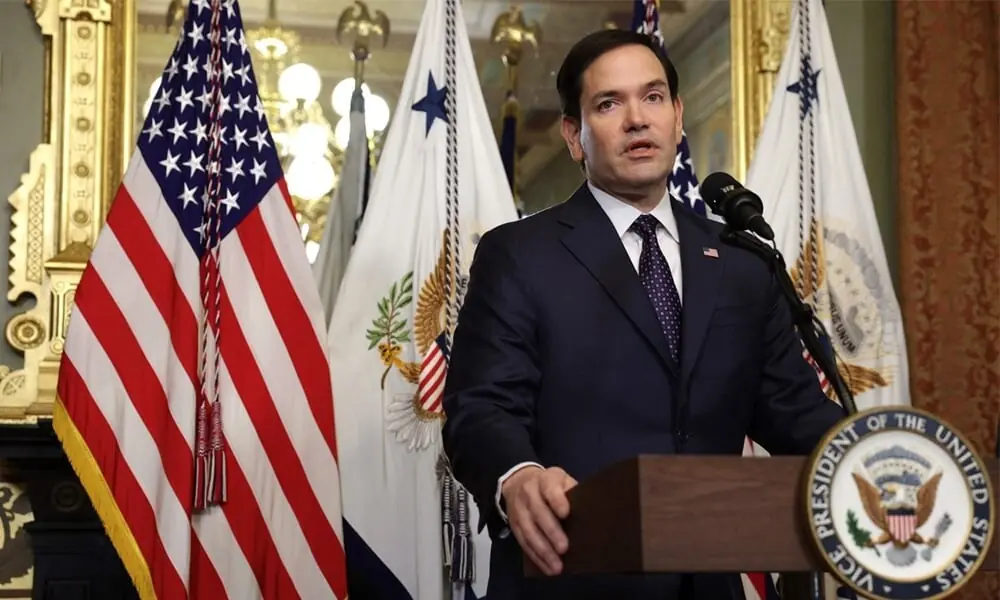
US Secretary of State Marco Rubio said on Sunday that progress has been made on an “outline” to open the Strait of Hormuz “without toll” but that would need “full Iranian acceptance and then compliance.”
“Some progress has been made, significant progress, although not final progress has been made,” Rubio told reporters in Indian capital New Delhi, referring to ongoing indirect talks between the US and Iran, mediated by Pakistan.
On the Strait of Hormuz, Rubio said: “This is an international waterway. They don’t own it. It’s an international waterway.”
Emphasising a diplomatic solution, Rubio said the US has “made some progress over the last 48 hours working with our partners in the Gulf region on an outline.”
The outline, he added, “that could ultimately, if it succeeds, leave us not just with a completely open straits — and I mean open straits without tolls — and with addressing some of the key things that underpin what has been Iran’s nuclear weapons ambitions in the past.”
Iranian air defenses have shot down an Israeli surveillance drone over the country’s southern Hormozgan province, Iran’s semi-official news agency Mehr reported on Sunday.
The wreckage of a destroyed Orbiter drone was found in coordination with Iranian naval forces, the outlet added.
Israel has yet to comment on the report.
A senior Iranian source told Reuters on Sunday that Tehran has not agreed to hand over its highly enriched uranium stockpile. The source said Iran’s nuclear issue was not part of the preliminary agreement with the US.