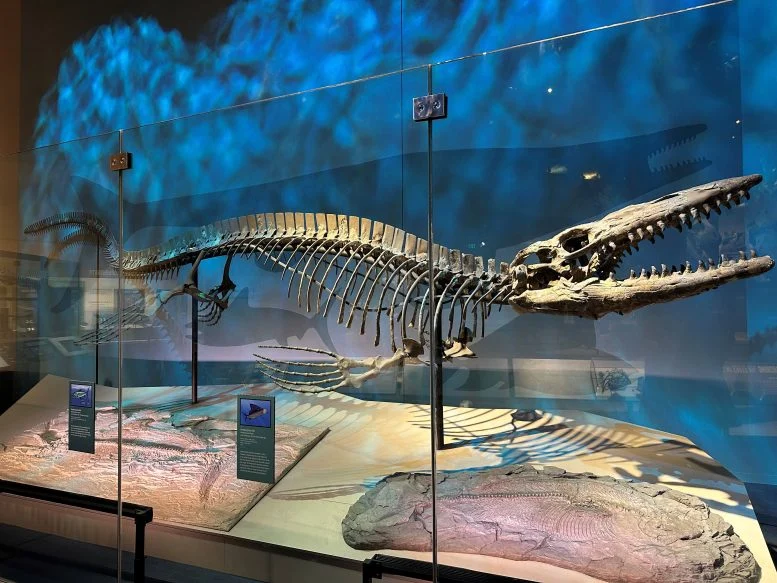
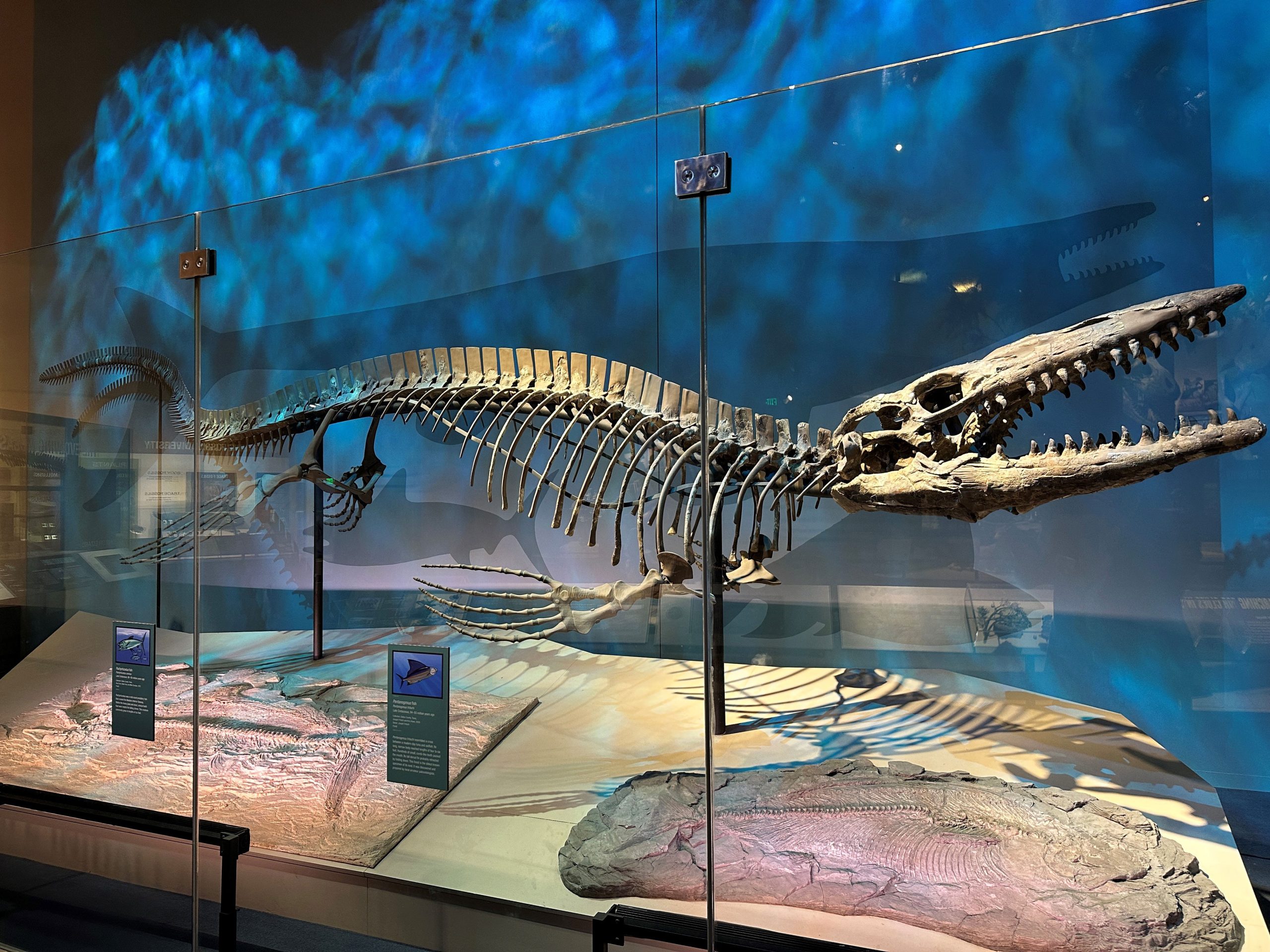
A newly identified mosasaur from Texas suggests that some ancient marine predators were larger, more powerful, and possibly more aggressive than previously recognized.
Bite marks, broken jaws, and a giant skull from Texas are helping scientists redraw the family tree of one of the ocean’s most fearsome ancient predators. The animal behind the evidence was not a dinosaur, but it lived alongside them and may have ruled its stretch of the sea with similar force.
Scientists from the American Museum of Natural History, the Perot Museum of Nature and Science in Dallas, and Southern Methodist University have identified a huge new species of mosasaur, a marine reptile that hunted in the oceans during the age of dinosaurs. The species has been named Tylosaurus rex, or T. rex, meaning “king of the tylosaurs.”
The predator was among the largest mosasaurs yet known, reaching up to 43 feet long. Its fossils are about 80 million years old and were found mostly in northern Texas, in rocks laid down when a shallow seaway covered much of central North America.
“Everything is bigger in Texas and that includes the mosasaurs, apparently,” said Amelia Zietlow, lead author of the new study, which was published today by the Bulletin of the American Museum of Natural History.
A Misidentified Fossil Reveals a New Species
Zietlow is a research associate at the American Museum of Natural History and is now at the History Museum at the Castle in Wisconsin. She began the project while earning her Ph.D. in comparative biology at the Museum’s Richard Gilder Graduate School. During that work, she found a mosasaur fossil in the Museum’s research collection that seemed to have been incorrectly identified as Tylosaurus proriger.
Zietlow and her colleagues compared the fossil with the holotype of T. proriger, the name-bearing specimen described more than 150 years ago and now held at the Harvard Museum of Comparative Zoology. They concluded that the American Museum of Natural History fossil, along with more than a dozen similar specimens in other collections, likely belonged to a different species.
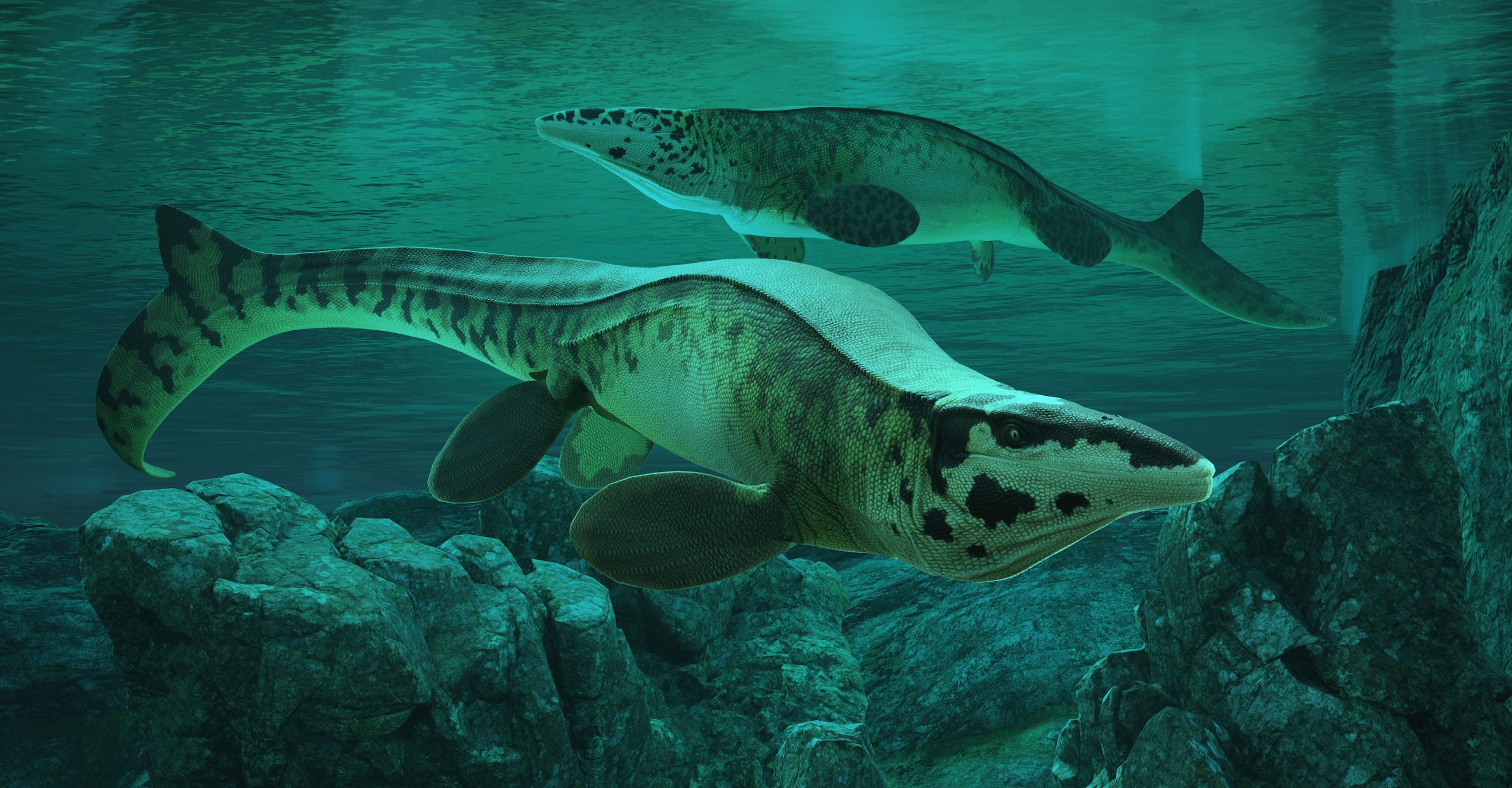
These fossils were larger than T. proriger and had finely serrated teeth, an unusual feature among mosasaurs. Most known T. proriger fossils come from what is now Kansas and are about 84 million years old. The newly identified fossils, by contrast, are mostly from Texas and are about 4 million years younger.
Honoring an Earlier Discovery
The name T. rex also honors paleontologist John Thurmond, who noticed in the late 1960s that tylosaurs from northeast Texas were unusually large and might represent a new species. He informally called them “Tylosaurus thalassotyrannus,” or “sea tyrant,” while also noting the cliché.
The holotype for the newly described T. rex is a giant specimen displayed at the Perot Museum that was first discovered in 1979 along an artificial reservoir near Dallas. Beyond T. rex’s impressive size, ranging from 25 feet to 43 feet—about the length of a school bus—the new species had a suite of adaptations for exceptionally strong jaw and neck muscles, suggesting that it was a powerful predator.
“Besides being huge, roughly twice the length of the largest great white sharks, T. rex appeared to be a much meaner animal than other mosasaurs,” said study co-author Ron Tykoski, vice-president of science and curator of vertebrate paleontology at the Perot Museum. “Through our study and examination of well-preserved fossils collected throughout the north Texas region, we have evidence of violence within this species to a degree not previously seen in other Tylosaurus specimens.”
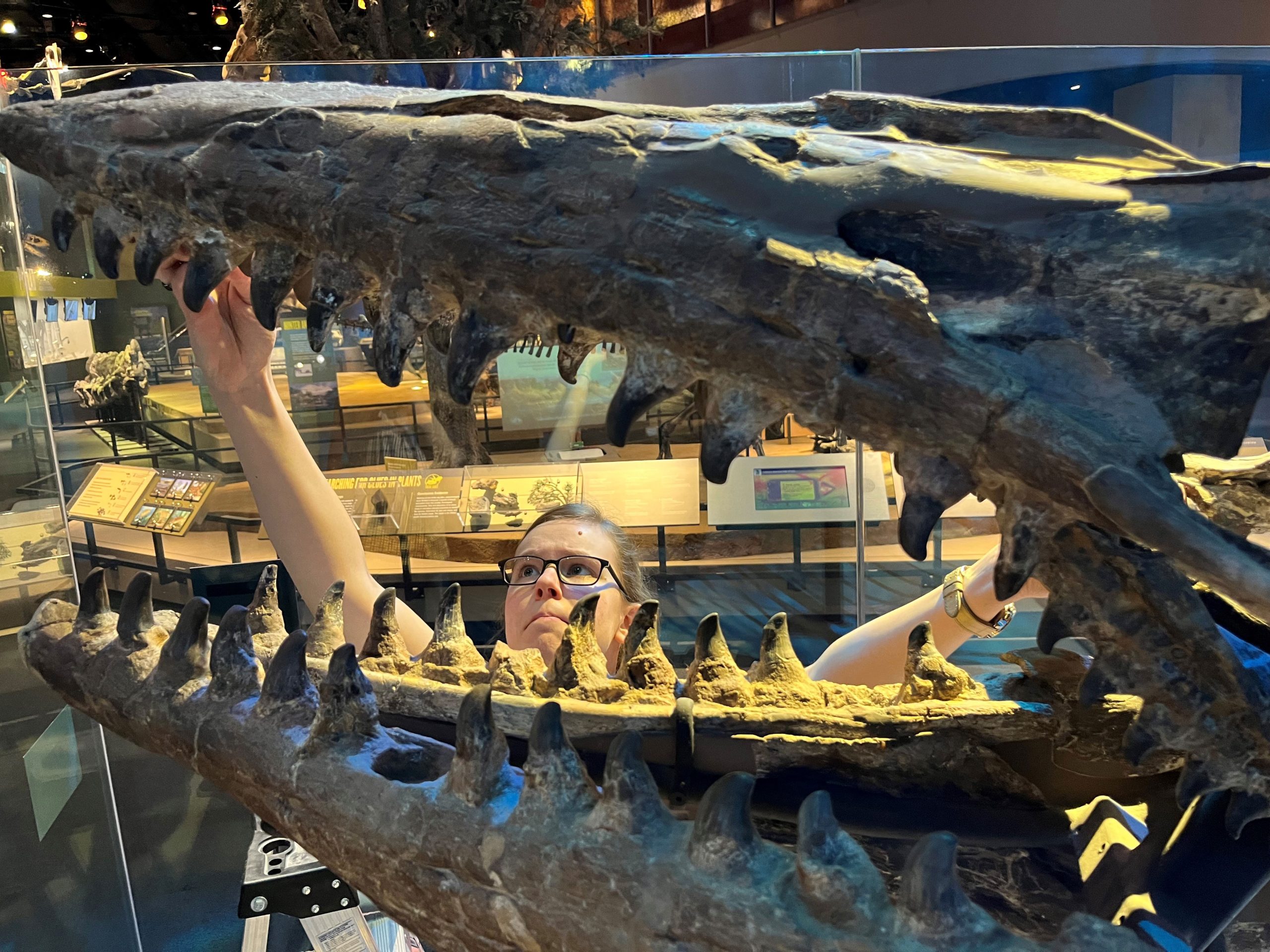
One fossil in the Perot Museum’s collection, nicknamed “The Black Knight,” may preserve signs of this aggression. The specimen is missing the tip of its snout and has a broken lower jaw. According to the researchers, injuries of that kind could only have been caused by another member of the same species.
Several well-known mosasaur fossils once identified as T. proriger will now be classified as T. rex. These include “Bunker,” a huge specimen found in 1911 and displayed at the University of Kansas, and “Sophie,” which is on display at the Yale Peabody Museum.
Rethinking Mosasaur Evolution
The study also tackles a major issue in mosasaur research. For nearly 30 years, scientists have relied on a largely unchanged dataset to study evolutionary relationships among mosasaurs.
For the new T. rex study, the team built a thoroughly revised dataset and proposed a new view of how tylosaurs are related. The findings suggest that mosasaur evolution should be revisited because many earlier studies depended on the same dataset with only limited changes.
“This discovery is not just about naming a new species,” Zietlow said. “It highlights the need to revisit long-standing assumptions about mosasaur evolution and to modernize the tools we use to study these iconic marine reptiles.”
Coauthor Michael Polcyn from Southern Methodist University added: “These findings reshape both the physical and evolutionary picture of mosasaurs, underscoring Texas as a key region for understanding ancient marine ecosystems and signaling a new era of research into the evolutionary history of these formidable predators.”
Reference: “A gigantic new species of Tylosaurus (Squamata, Mosasauridae) from Texas : and a revised character list for phylogenetic analyses of Mosasauridae (Bulletin of the American Museum of Natural History, no. 482)” by Amelia R. Zietlow, Michael J. Polcyn and Ronald S. Tykoski, 21 May 2026, Bulletin of the American Museum of Natural History.
DOI: 10.5531/sd.sp.84
Support for this research was provided in part by the National Science Foundation, Grant # 1938103, the Dallas Paleontological Society, the Society of Systematic Biologists, the Richard Gilder Graduate School, the Gingrich Fund, and the Carter Fund.
Never miss a breakthrough: Join the SciTechDaily newsletter.
Follow us on Google and Google News.