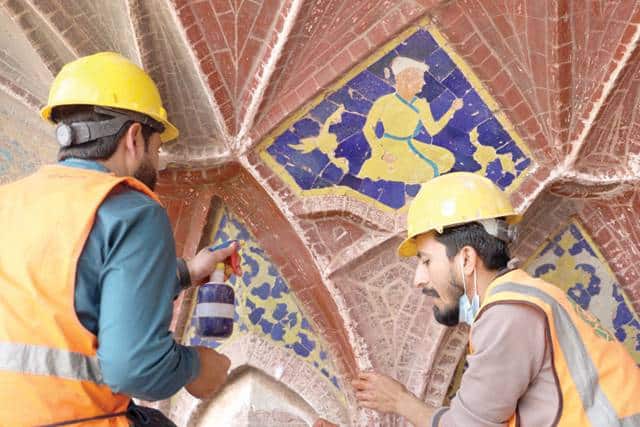

LAHORE – Marking a milestone for cultural heritage conservation in Pakistan, UNESCO has hailed the completion of the conservation of the Northern section of Lahore Fort’s Picture Wall as ‘a landmark conclusion… of one of the most ambitious heritage conservation endeavors in the country’s history.’ The Picture Wall of Lahore Fort tells a 400-year story across one of the world’s largest and most intricate mural walls. Constructed during the reigns of the Mughal Emperors Jahangir and Shah Jahan in the seventeenth century, the nearly half-kilometre-long wall features approximately 2,000 intricately decorated recessed panels arranged across three tiers. Featuring exquisite depictions of flora, fauna, and geometric motifs, the wall reflects the unparalleled artistic mastery of the Mughal era. The panels portray myths and legends from Indo-Persian folklore. The depictions include hunting scenes, royal processions, angels and demons, animals, birds, geometric designs, and floral motifs, crafted through techniques such as glazed tile mosaic (Kashikari), fresco painting, marble and red sandstone jali work, and terracotta relief. The wall represents a diversity of skills through the work of architects, engineers, scientists, artists, and conservators. Similarly, the collective contribution of a range of stakeholders – including Aga Khan Cultural Service – Pakistan, the Walled City of Lahore Authority (WCLA) and donors including the US Embassy, French Embassy and the Royal Norwegian Embassy have led to the successful conservation of the historic site. Each stakeholder brought distinct contributions to the project. The Government of Punjab, through the Walled City of Lahore Authority (WCLA), provided institutional support, while the Royal Norwegian Embassy, the German Federal Foreign Office through the German Embassy, and the United States Ambassadors Fund for Cultural Preservation contributed international funding. Aga Khan Cultural Service – Pakistan (AKCS-P) carried out all onsite conservation and restoration work and has been the implementing agency during the course of the project. Fuad Pashayev, Country Representative to Pakistan, UNESCO, termed the completion of the Picture Wall “a testament to what can be achieved when scientific rigor, international solidarity, and local expertise work in concert.” He went on to state, “UNESCO is proud to have witnessed this journey and to see that the conservation work has been recognised as strengthening the Outstanding Universal Value of this exceptional World Heritage property. We encourage Pakistan to carry this model of excellence forward.” Initiated in 2015 and formally launched for conservation in 2018, the project was implemented through a phased programme of scientific conservation. The rigorous and sustained process of revival was completed in April this year. Prior to this project, the Picture Wall exhibited significant material decay, structural distress, and surface deterioration. These conditions included missing sections due to detachment, moisture damage caused by ineffective historical drainage systems, structural cracking, fungal growth, and surface soiling. The approach towards the wall’s conservation has been on the careful preservation of structures rather than redesign – safeguarding authenticity while ensuring the site’s longevity. The methodic process involved removing later-added plaster, treating biofilm growth on the surfaces, reintegrating fresco and brick imitation work, consolidating tile mosaics and glazes, and applying new plaster to establish a coherent visual composition for viewers. The ground beneath the prototype area was also excavated to reveal the original ground level. Preceding this, during the first phase of the project, comprehensive documentation of the entire Picture Wall was done, using advanced technologies such as 3D laser scanning, Electronic Distance Measurement (EDM) devices, and high-resolution ortho-rectified photography. This was also the first conservation project in Pakistan in which comprehensive scientific research and analysis were carried out as a preliminary exercise at this scale. Under the picture wall project, a new generation of Pakistani heritage professionals, including conservators, architects, engineers, fine artists, and craftspeople, was trained in methods grounded in international best practice, with a notably high proportion of women, including site chemists, conservation architects, archaeologists, ceramists, and skilled artisans, reflecting a commitment to inclusivity and strengthening local capacity. The project also contributed to the revival of traditional skills such as Kashikari (glazed tilework) and Naqqashi (fresco painting) through apprenticeships and formal training workshops, further strengthening long-term local capacity in heritage conservation across the Walled City and beyond. CEO AKCS-P, Tausif Khawaja, described the Picture Wall as “a key reason for the Lahore Fort’s UNESCO World Heritage status. This project has proven that world-class heritage conservation is achievable in Pakistan.” Reflecting on the meticulous nature of the work, he added, “Each panel was carefully considered through extensive discussion on what should be restored and what should remain untouched.” To mark the completion of the Picture Wall, AKCS-P, in partnership with WCLA, plans to organise a grand opening event welcoming visitors and dignitaries from Pakistan and around the world.