Tehran says new US strikes violate ceasefire Khamenei warns US will no longer be able to use Gulf States as safe haven Rubio insists deal still possible Trump says Tehran must hand over enriched uranium or destroy it.
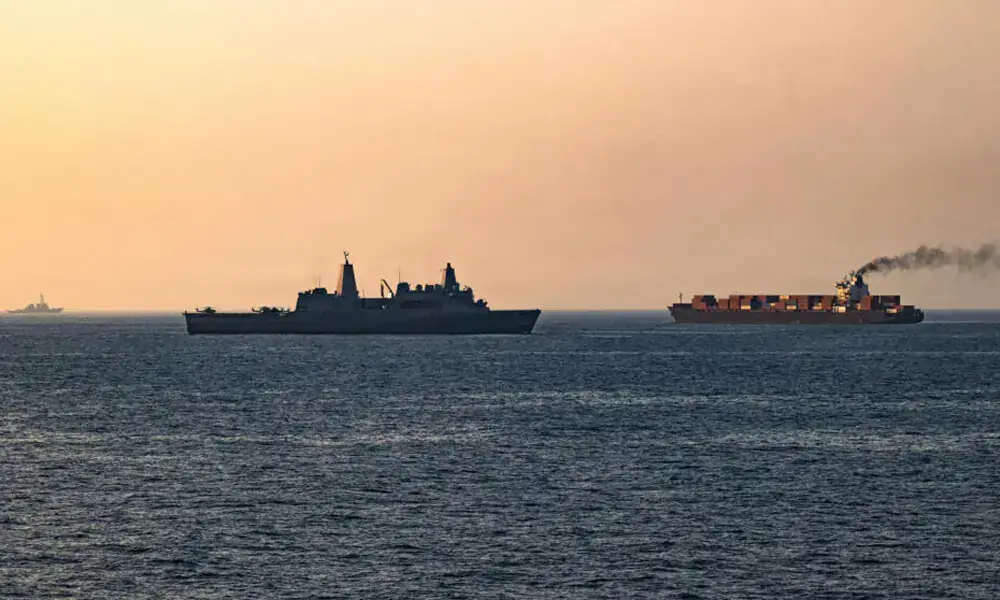
Washington/Tehran/Dubai – US forces attacked missile sites in southern Iran and boats trying to lay mines on Monday, US Central Command said Tuesday, as top Iranian negotiators arrived in Doha for talks to end the war.
In the aftermath of the strikes, Iranian Supreme Leader Ayatollah Mojtaba Khamenei issued a thinly veiled threat, warning that the US would no longer have any safe havens in the region.
“US forces conducted self-defense strikes in southern Iran today to protect our troops from threats posed by Iranian forces,” Tim Hawkins, a US Central Command spokesman, said in a statement. It gave no details of the attacks and said only that the targets included missile launch sites and boats trying to “emplace mines.”
Unconfirmed reports from Iran claimed four Revolutionary Guards members were killed in American strikes in southern Iran’s Bandar Abbas.
Iranian media reported explosions were heard in the port city and coastal areas near the Strait of Hormuz. The Mehr news agency said the situation in Bandar Abbas was under control.
Hours later, the IRGC said it had downed a US drone and shot at other aircraft attempting to enter the country’s airspace, without specifying when the incidents took place.
In a statement, the IRGC further warned “against any violation of the ceasefire by the aggressor US military and considers its right to reciprocal response legitimate and certain.”
The overnight strikes threatened an already fragile ceasefire that began April 8 as the United States and Iran struggle to reach an accord to end a war that has rattled the global economy with a severe disruption of energy flows. Washington and Tehran have played down hopes for an imminent breakthrough.
There was no immediate reaction to the development by Iranian officials, although Khamenei published a statement on his Telegram channel warning that the Gulf powers would no longer be a shield for United States bases and that Washington would no longer have a safe haven in the region. He said the US “in addition to no longer having any safe haven in the region for aggression and the establishment of military bases, is moving further and further away from its former position with each passing day.
Several US bases in the Middle East were attacked by Iran during the recent war, and the Gulf states that host US assets were bombarded by missile and drone strikes.
Khamenei has not appeared publicly since he was named as Iran’s supreme leader on March 8 following the death of his father and predecessor, Ali Khamenei. Since then, he has issued only written statements, fueling speculation about his health after he was injured in strikes.
Prior to the overnight flare-up of tensions, US Secretary of State Marco Rubio told reporters in New Delhi that the US would give diplomacy every chance to succeed before considering whether to deal with Iran in “another way.”
He doubled down on his remarks after the military action, saying that a deal with Iran was still possible, despite the strikes.
“There were some talks going on in Qatar today, so we’ll see if we can make progress. I think it’s a lot of talking back and forth going on about specific language in the initial document, so it’ll take a few days,” Rubio told reporters in Jaipur during an official visit to India.
“The president expressed his desire to make it. He’s either going to make a good deal or no deal,” he said, warning that the Strait of Hormuz, a vital global shipping route, was “going to be open one way or another.”
“What’s happening there is unlawful, it’s illegal, it’s unsustainable for the world, it’s unacceptable,” Rubio added.
‘A Great Deal for all, or no Deal at all’
In a lengthy post on Truth Social on Monday, US President Donald Trump said talks with Iran were going “nicely,” but warned of fresh attacks if they failed. It “will only be a Great Deal for all, or no Deal at all,” he wrote.
Trump also said in a social media post that he expected Iran to hand over its enriched uranium to the United States to be destroyed, or have it destroyed in Iran with an international witness.
“The Enriched Uranium (Nuclear Dust!) will either be immediately turned over to the United States to be brought home and destroyed or, preferably, in conjunction and coordination with the Islamic Republic of Iran, destroyed in place or, at another acceptable location, with the Atomic Energy Commission, or its equivalent, being witness to this process and event,” Trump wrote on Truth Social.
The Atomic Energy Commission was a US government agency that was abolished in 1974. The UN’s nuclear watchdog is called the International Atomic Energy Agency (IAEA).
Trump also did not specify whether he was concerned only with the 440 kilograms of highly enriched uranium in Iran’s possession, which is a short step away from weapons-grade, or if he was referring to its full stockpile, which US officials have reportedly insisted would need to be removed as part of any deal.