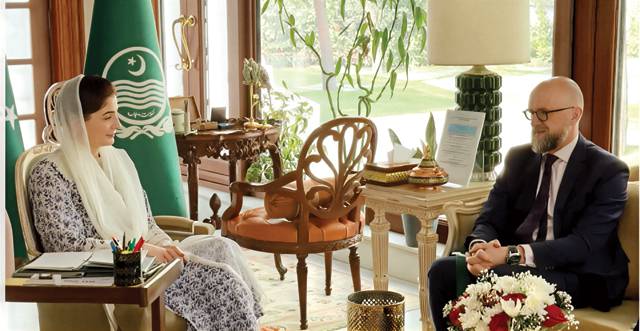

LAHORE – Punjab Chief Minister Maryam Nawaz Sharif met with Asian Infrastructure Investment Bank (AIIB) Chief Investment Officer Konstantin Limitovskiy in Lahore and discussed matters of mutual interest, including expanding institutional cooperation and collaboration on development initiatives in Punjab.
AIIB Director General Xiaohong Yang was also present during the meeting. During the meeting, the chief minister briefed the delegation on the Punjab government’s ongoing development projects and offered the AIIB partnership opportunities in various infrastructure and development schemes across the province.
Maryam Nawaz said the Punjab government’s flagship housing initiative, “Apni Chhat Apna Ghar,” received appreciation during the 13th session of the World Urban Forum held in Baku. She said that more than 100,000 houses had been built under the programme within a year.
The chief minister said the electric bus and e-bike programmes were being successfully implemented across Punjab to promote environmentally friendly transportation.
Welcoming Konstantin Limitovskiy to Lahore, which she described as Pakistan’s cultural hub, Maryam Nawaz said Punjab highly valued its partnership with the AIIB. She appreciated the bank’s cooperation in signing an MoU aimed at improving water supply and sanitation infrastructure in Lahore.
She said the agreements reflected AIIB’s confidence in Punjab’s development and reform agenda.
The chief minister highlighted that the Lahore Wastewater and Drainage Management Project, including the sewerage network and a wastewater treatment plant at Babu Sabu, would significantly improve the city’s drainage system. Maryam Nawaz said cooperation with the AIIB would bring positive changes to urban culture and civic infrastructure in Punjab.
She also appreciated the bank’s support for the proposed surface water treatment plant at the BRBD Canal project.
The chief minister said Punjab was moving rapidly towards environmental protection and improved public health, adding that the province was adopting a new model of urban governance based on data planning, technology monitoring and climate-smart infrastructure.
She reiterated that the Punjab government’s top priorities included provision of clean drinking water, healthcare facilities and a modern transport system for the public.